B200 Rental Price March 2026 Update

B200 Rental Price March 2026 Update

B200 GPU rental prices in March 2026: market data from 30 providers and 3,213 quotes covering on-demand, spot, and reserved rates — with provider-by-provider breakdowns and pricing band analysis.

Yuhua Yu

Written by

Carmen Li

Founder at Silicon Data

#

Industry

0 Mins Read
0 Mins Read

B200 Rental Price March 2026 Update

B200 Rental Price March 2026 Update

B200 GPU rental prices in March 2026: market data from 30 providers and 3,213 quotes covering on-demand, spot, and reserved rates — with provider-by-provider breakdowns and pricing band analysis.

Yuhua Yu

Written by

Carmen Li

Founder at Silicon Data

#

Industry

0 Mins Read

You're reading

B200 Rental Price March 2026 Update

Table of Content

Updated March 28, 2026

The B200 rental market is no longer hypothetical. March 2026 delivered a real, multi-provider cloud market with meaningful price segmentation — but the underlying pattern is more nuanced than a simple breakout story. Across 3,213 public March quotes from 30 providers, the simple average sat at $5.66 per GPU-hour while the median sat at $4.45. That gap matters: a relatively small group of premium, bundled, and managed offers kept the average elevated, while the middle of the market cleared much lower.

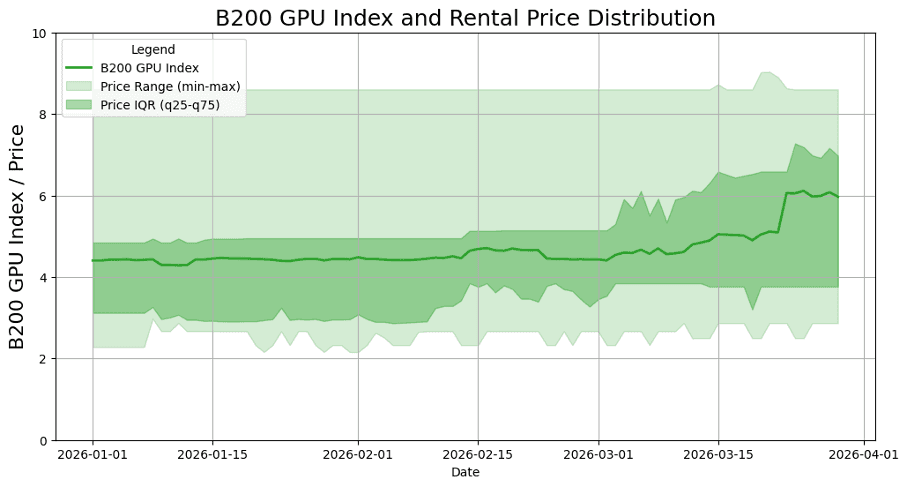
As of March 28, 2026, the SDB200RT index , Silicon Data's standardized benchmark for B200 cloud gpu pricing , sits at $5.99 per GPU per hour, up sharply from a floor of approximately $4.54 just three weeks ago

By the latest March 28 snapshot, the market was still wide rather than one-directional: the daily median was $4.47, the daily average was $5.62, and the daily observed range ran from $1.59 to $19.23. Over the full month, the 10th-to-90th percentile band sat at roughly $1.95 to $9.67, while the absolute range stretched from a brief $0.23 spot outlier to $19.23 on a premium managed listing.

The right read on March, then, is not that every B200 rate moved higher. The more accurate read is that the floor reset upward after the first week, the middle of the market stabilized in the mid-$4s, and the premium top end stayed expensive all month. That is a very different procurement signal from a clean market-wide rally.

Method note: unless otherwise stated, the pricing discussion below refers to public March 2026 B200 rental quotes observed across cloud providers and marketplaces. Because offers mix GPU-only, full-node, spot, and reserved products, median pricing is often more useful than the raw average.

March mean$5.66/hr

March median$4.45/hr

10th–90th band$1.95–$9.67

Observed full range$0.23–$19.23

Providers observed30 in March

Latest live providers29 on Mar 28

Latest daily median$4.47/hr

Quote count3,213 listings

Overview of the B200 GPU Rental Market Heading Into Late March 2026

Current State of B200 Availability

B200 access is now undeniably broad on cloud, even if it is not frictionless. March quotes covered 30 named providers and 29 were still live on the latest daily snapshot. That is enough breadth for genuine price discovery; most teams shopping for B200 no longer need to anchor on a single vendor conversation.

The major clouds also have formal products now. AWS documents P6-B200 instances with 8 Blackwell GPUs, 1.44 TB of GPU memory, 2 TiB of system memory, and 30 TB of local NVMe. Google documents A4 VMs with 8 B200s, 224 vCPUs, 3,968 GB of memory, and access paths that run through reserve capacity, Spot, Flex-start, or managed resize workflows rather than a purely open, unlimited on-demand model. In other words: availability is real, but quotas, reservations, and capacity planning still matter.

Key Demand Drivers Keeping B200 Expensive

The technical case for B200 remains strong. Blackwell-class B200 systems pair 180 GB of HBM3e per GPU with FP4 support and very fast fifth-generation NVLink/NVSwitch interconnects. That combination is exactly what memory-heavy training, long-context inference, and dense multi-GPU serving clusters care about.

That is why B200 keeps a premium even as more vendors list it. Buyers are not just paying for a newer GPU. They are paying for a larger memory envelope, better low-precision inference economics, and easier scaling inside dense nodes.

Figure 1. Daily March quote band across all tracked B200 listings. The key correction is that the market did not uniformly break higher; instead, the floor reset after March 5 while the upper band stayed broadly unchanged.

What Actually Supported Pricing in March

March pricing was shaped less by a single universal shortage story and more by market structure. The market now contains at least three different products under the same “B200” label: low-friction neocloud offers, marketplace supply that moves around with seller inventory, and bundled hyperscaler or managed-node offers that include much more than raw GPU time.

That segmentation is why the mean and median diverge so much. A premium whole-node or managed listing can sit near $9 to $19 per GPU-hour without telling you much about where flexible buyers can actually clear the market.

Two Acts: March’s Floor Reset, Then Stabilization

Because the clean pricing window for this refresh is March itself, the most defensible way to read the month is to split it in two: the opening five days, when the lower tail was still noisy and extremely cheap outliers were present, and the rest of the month, when the floor moved up and the market settled into a tighter center.

Act 1 — March 1–5: Wide Dispersion and Outlier Noise

The month opened with a very wide distribution. The daily average across all quotes was already in the mid-$5.55 range, but the daily median averaged just $3.98 because a handful of extremely low listings pulled down the lower tail. The most extreme example was a brief $0.23 spot quote; even the lowest on-demand quote early in the month came in under fifty cents.

That was never the true center of the market. It was a reminder that the raw tape included highly interruptible, promotional, or niche supply alongside much more expensive whole-node and managed offers.

Act 2 — March 6–28: Floor Reset and a Stable Mid-Market

After March 5, the floor reset sharply higher. The observed daily low moved to roughly $1.59–$1.75 for the rest of the month, and the daily median stabilized around $4.47. The daily average barely changed — $5.68 for the remainder of the month versus $5.55 in the first five days — which tells you the premium top end was already there.

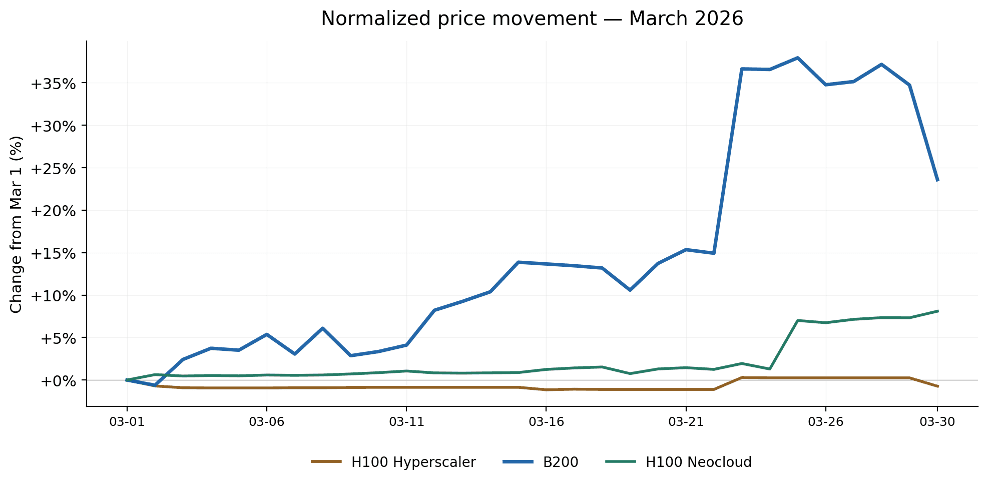
So the major correction to the earlier narrative is this: March was not a clean conviction rally from the low $4s to the $5s across the entire market. It was a floor reset plus a middle-of-market repricing. The premium upper band stayed sticky all month, while the center of the distribution moved up and then held.

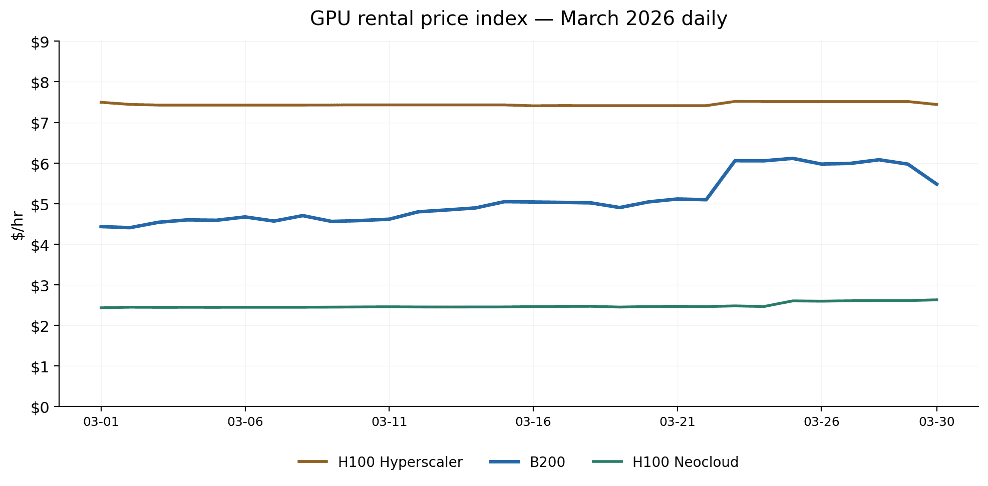
Figure 2. Median quote by market tier. Hyperscaler pricing stayed expensive and fairly flat; the meaningful March move came from the middle of the market, especially marketplace-style supply.

B200 Rental Pricing Data Points and Rates as of Late March 2026

On-Demand B200 Rental Prices Across Major Providers

For the full month, on-demand B200 quotes carried a $5.95 median and a $6.61 mean. That is already a more useful benchmark than quoting a single vendor or a single headline outlier.

On the March 28 snapshot, representative on-demand quotes started at $1.95 and ran through $15.22. The cheap end was dominated by neocloud and lighter-weight specialist offers. The upper end was concentrated in hyperscaler or heavily managed products.

Provider

Representative on-demand quote(Mar 28, USD/hr)

Market tier

AX3

$1.95

Specialist / neocloud

Genesis Cloud

$2.80

Specialist / neocloud

Vultr

$2.94

Specialist / neocloud

Sesterce

$3.74

Specialist / neocloud

TensorPool

$4.99

Specialist / neocloud

Nebius

$5.50

Specialist / neocloud

RunPod

$5.98

Marketplace / managed

Lambda

$6.84

Specialist / neocloud

CoreWeave

$8.60

Specialist / neocloud

Google Cloud Platform

$9.00

Hyperscaler

Amazon Web Services

$13.49

Hyperscaler

AnyScale

$15.22

Marketplace / managed

Table 1. Selected late-March on-demand examples. Representative quote = the lowest public on-demand listing observed for that provider on March 28.

Spot Pricing for B200 GPU Rentals in March 2026

Spot remained the cleanest lever for buyers willing to handle interruption, but the observed market was not as extremely cheap as early anecdotes suggested. Over the full month, spot carried a $2.96 median and a $3.39 mean. On March 28, spot quotes ranged from $1.59 to $4.45 across six providers.

The main lesson is not that spot is always ultra-cheap. It is that spot compresses the lower half of the market. Once the opening-week outliers disappeared, most spot supply lived in a much narrower mid-$1s to mid-$4s band.

Spot example

Mar 28 quote

Market tier

Mithril

$1.59

Specialist / neocloud

DataCrunch

$1.67

Marketplace / managed

HPCAI

$1.75

Marketplace / managed

Google Cloud Platform

$2.71

Hyperscaler

RunPod

$3.59

Marketplace / managed

Vast AI

$4.45

Marketplace / managed

Reserved and Longer-Term B200 Rates

Reserved pricing sat between spot and on-demand in a more orderly way. March reserved quotes had a $4.52 median and a $5.98 mean, with most late-month offers clustering between about $2.45 and $5.46.

That makes reserved the most rational option for teams with predictable weekly utilization but not enough certainty to pay the full whole-node premium of the major clouds.

Reserved example

Mar 28 quote

Market tier

Hyperstack

$2.45

Marketplace / managed

FPX Marketplace

$3.00

Marketplace / managed

Civo

$3.09

Specialist / neocloud

HPCAI

$3.35

Marketplace / managed

Together AI

$4.00

Specialist / neocloud

Bitdeer

$4.22

Specialist / neocloud

DataCrunch

$4.40

Marketplace / managed

Vast AI

$4.45

Marketplace / managed


Figure 3. March distribution by purchasing model. Spot sat materially below on-demand, while reserved clustered in between and behaved more predictably.

B200 NVL72 and Pod-Scale Pricing

Pod-scale and rack-scale pricing is still much less transparent than single-GPU or single-node pricing. Public menus increasingly show full HGX or GB200-class nodes, but true multi-rack procurement is still often handled through reservation products or sales-led deals. For most readers, the practical market to monitor remains per-GPU or per-node B200, not full-rack list pricing.

Cloud Provider-by-Provider B200 Rental Price Comparison

Hyperscaler B200 Rental Pricing

The hyperscalers stayed expensive because their offers are not lightweight GPU-only rentals. AWS’s documented P6-B200 instance is an 8-GPU node with 2 TiB of system memory and 30 TB of local NVMe, while Google’s A4 is an 8-GPU machine with 224 vCPUs and 3,968 GB of memory. Those are powerful products, but they are also far more bundled than a marketplace slice or a neocloud pod.

That difference shows up clearly in March pricing. The observed hyperscaler band held high throughout the month: the median hyperscaler quote across March was $9.67, and even the lower end of tracked hyperscaler pricing started well above the typical neocloud floor.

Specialized Clouds and Neocloud Platforms

Specialized providers and neoclouds were where most practical price discovery happened. Across March, neocloud quotes carried a $2.95 median and a $3.62 mean — dramatically lower than the hyperscaler band.

This is where buyers found the real working market: roughly $2.8 to $6.0 for many late-March on-demand offers, lower on spot, and modestly below that on reservations. CoreWeave, Lambda, Nebius, RunPod, TensorPool, Genesis Cloud, Vultr, and similar platforms made up the usable middle of the market.


Figure 4. Selected on-demand examples from March 28. The spread is real, but it reflects very different products: low-friction neocloud offers, self-serve specialist clouds, and highly bundled premium platforms.

Marketplaces and Brokered Supply

Marketplaces sat between those extremes. Their March median was $4.76, but the category was noisy because it mixed commodity supply with very expensive managed listings. AnyScale, for example, sat at the top of the market, while other marketplace offers tracked much closer to the neocloud band.

The takeaway is simple: marketplace pricing is informative, but you should not treat every marketplace quote as a neutral market-clearing rate. Some listings are highly efficient spot-like supply; others are effectively managed-service premiums.

The B200 Premium: Focus on the Node, Not Just the Sticker Price

The right way to think about B200 is not “how much more than H100?” in the abstract. It is “what hardware envelope am I actually renting?”

On Google’s current accelerator families, A4 B200 gives you 1.44 TB of total GPU memory per 8-GPU node. A3 Ultra H200 gives 1.128 TB. A3 Mega H100 gives 640 GB. That memory step-up alone materially changes which models fit cleanly, how much batching you can push, and how often you have to trade simplicity for aggressive sharding or compression.

AWS makes the same point from the performance side: P6-B200 advertises up to 2.25x the GPU TFLOPs, 1.27x the GPU memory size, and 1.6x the memory bandwidth versus P5en. So yes, B200 menu prices are higher — but the capability step-up is large enough that pure sticker comparisons often understate the value for memory-bound or latency-sensitive workloads.

B200 vs. Alternative GPU Rental Choices

B200 vs. H100

For teams already running H100, the real question is whether the workload is constrained by memory, interconnect, or low-precision inference efficiency. If not, H100 remains the more economical default for prototyping, smaller fine-tunes, and general-purpose training runs. (For a full history of H100 pricing, see H100 Rental Price Over Time.)

If yes, B200’s premium is much easier to justify. The memory step from 80 GB to 180 GB per GPU and the presence of FP4 support fundamentally change what can be done without contorted parallelism or more aggressive model compression.

B200 vs. H200

H200 remains the most relevant middle ground. It meaningfully closes the memory gap versus H100 while avoiding the full B200 premium. If your workload needs more memory than H100 but does not clearly benefit from the broader Blackwell feature set, H200 remains a rational compromise.

Vendor / menu

B200 example

Comparable H100/H200 example

Read-through

RunPod (current self-serve menu)

$5.98 / hr

$3.59 / hr for H200

A usable real-world premium, not an infinite one

AWS posted Capacity Blocks pricing

$9.36 per accelerator

$3.93 for H100

Upper-band, capacity-backed whole-node pricing

Lambda posted public menu

$6.69 / GPU-hr

$3.99 / GPU-hr for H100

Specialist-cloud premium still lands in a manageable band

Table 2. A public-menu cross-check rather than a market-clearing index. The point is not that every B200 premium is identical; the point is that B200 carries a real, persistent premium that varies by packaging and commitment model.


Figure 5. Posted public-menu comparison at quarter-end. Not apples-to-apples across every vendor, but directionally consistent with the March market: B200 commands a real premium over H100/H200 alternatives.

What to Optimize For

If you are capacity constrained by model size, KV cache, batch size, or multi-GPU communication, B200 earns its keep quickly. If your main constraint is simply budget per experiment, cheaper H100 or H200 paths will usually produce better aggregate throughput per dollar spent across a portfolio of jobs.

Cost Analysis and Pricing Models for B200 Rentals

Total Cost of Renting B200 GPUs: Beyond the Base Rate

The biggest error in B200 procurement right now is comparing unlike products. A $2.8 to $5.0 quote is often a GPU-forward offer with lighter bundling. An $8 to $15 quote often includes a whole node, substantial CPU and RAM, local SSD, or a managed environment.

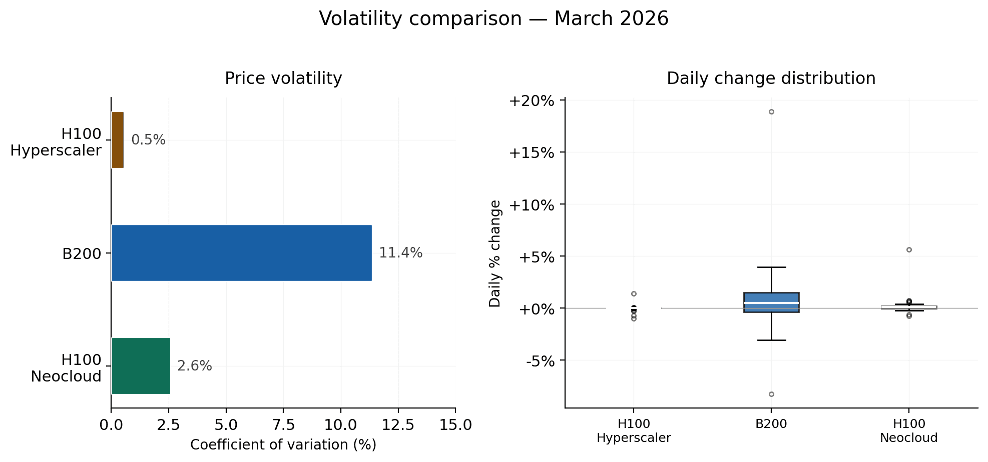
That is why using the median together with the provider profile matters more than chasing a single headline low. A market with a $5.66 mean and a $4.45 median is telling you that structure matters at least as much as the chip itself.

B200 Rental Pricing Models Across the Market

Spot is the best fit for fault-tolerant training and batch inference. Reserved is the most useful option for steady weekly load. On-demand is the cleanest option for bursty production or for teams that want maximum flexibility without engineering around interruption.

The March data supports that common-sense stack: spot undercut the market materially, reserved trimmed meaningful cost off on-demand, and on-demand remained the reference price for flexible access.

If you can checkpoint cleanly, start with spot. If you have a stable base load, reserve only the floor you know you can use. If you need compliance, specific regions, or whole-node guarantees, budget for the hyperscaler or managed premium instead of pretending those offers are interchangeable with marketplace slices.

Why March Prices Moved the Way They Did

March’s price action looks much clearer when you separate structural drivers from noise.

Driver 1: the lower tail disappeared. The ultra-cheap listings that pulled the first week down did not persist. Once those vanished, the observed floor rose to roughly $1.6–$1.9 and stayed there.

Driver 2: the middle of the market reset higher. Marketplace medians moved up after the opening days and stayed higher through the rest of the month. That is why the daily median stepped from roughly $4.0 in the first five days to roughly $4.47 thereafter.

Driver 3: the upper band never really moved. Hyperscaler and premium managed offers remained parked in the same high band throughout the month. That kept the mean in the mid-$5s even when the lower half of the market changed materially.

In short: March was not a straight-line bull run. It was a cleaner and more defensible repricing of the market center. The reason the upper band stayed sticky is straightforward: public-cloud B200 products are large, bundled machines with quota or reservation mechanisms, while neocloud and marketplace products are far more granular.

Outlook and Key Takeaways for B200 Rental Pricing After March 2026

Expected Direction into Q2

As March closes, the most defensible near-term view is not that B200 prices are exploding. It is that the cheap tail has normalized and the mid-market has reset higher. That suggests a firmer market than the first week implied, but still not a single universal clearing price.

Strategic Recommendations for Buyers

  • Anchor on median and percentile bands, not just the highest-profile list price.

  • Split comparisons by on-demand, reserved, and spot before drawing conclusions.

  • Treat hyperscaler rates as full-stack whole-node pricing rather than as clean per-GPU comps against lighter-weight specialist offers.

  • If you need the Blackwell envelope — 180 GB HBM3e, FP4, and faster multi-GPU scaling — pay the premium intentionally. If not, do not.

Summary of the March 2026 Landscape

  • Full-month average quote: $5.66 per GPU-hourFull-month median quote: $4.45 per GPU-hour10th–90th percentile band: $1.95 to $9.67Full-month observed range: $0.23 to $19.23Latest-day median: $4.47 per GPU-hourOn-demand / reserved / spot medians: $5.95 / $4.52 / $2.96Providers observed in March: 30

B200 is unquestionably a real cloud market now, but it is still a segmented one. The best late-March read is not that every rate is marching upward. It is that the market has settled into three bands: low-cost flexible supply, a usable mid-market specialist tier, and a sticky premium top end. Teams that understand which band matches their workload will make better buying decisions than teams that chase a single headline number.

Track B200 Pricing in Real Time with Silicon Data

In a market where B200 rental prices can shift meaningfully within a single month—individual providers cutting rates by 34% or raising them by 16%—real-time intelligence isn’t a nice-to-have. It’s the difference between locking in a reserved rate at the right moment or overpaying for the same compute.

This entire update has been built on data from Silicon Data’s platform, and we’d recommend it to any team actively managing GPU pricing decisions. Here’s what’s relevant to your workflow:

SiliconNavigator tracks rental and resale prices across 50 GPU chipsets with 3.5 million+ data points, updated daily. It’s where you go when you want to see what every provider is charging right now, with historical context going back up to 8 years.

SiliconIndex (SDB200RT, SDH100RT, and others) provides the standardized benchmarking we've referenced throughout this article. These indices cover 80%+ of global H100 rental activity and are the same data points traders and financial institutions use for hedging and pricing derivatives.

SiliconPriceIQ gives you AI-driven predictive GPU pricing forecasts by chip, region, configuration, and rental terms—on-demand, reserved, and spot. It’s the forward-looking layer on top of the real-time data.

All of these tools are available via API for enterprise workflow integration, which matters if you're running automated procurement or feeding GPU pricing data into financial models.

Given the pricing dynamics we’ve observed in March 2026—from AX3’s aggressive price cut to Lambda Labs’ rate increase to the broader impact of GTC 2026—we’d encourage anyone actively renting or evaluating B200 compute to talk to the Silicon Data sales team about what enterprise-grade market intelligence looks like for your organization. The data pays for itself the first time you avoid a bad timing decision.

Yuhua Yu
Yuhua Yu

Written by

Carmen Li

Founder at Silicon Data

Share this story

Subscribe to our Newsletter

Subscribe to our Newsletter

Articles you may like

Make better compute decisions today

Realtime price transparency & GPU performancedata for traders, financial institutions, and builders.

© 2025 Silicon Data® is a registered trademark of Silicon Data Inc. All rights reserved.

Ask AI for a summary of Silicon Data

Make better compute decisions today

Realtime price transparency & GPU performancedata for traders, financial institutions, and builders.

© 2025 Silicon Data® is a registered trademark of Silicon Data Inc. All rights reserved.

Ask AI for a summary of Silicon Data

Make better compute decisions today

Realtime price transparency & GPU performancedata for traders, financial institutions, and builders.

© 2025 Silicon Data® is a registered trademark of Silicon Data Inc. All rights reserved.

Ask AI for a summary of Silicon Data