
Cash-Settled Compute Futures
Physical delivery or cash settlement? Why cash settlement is the right first design for the institutional hedging tool the AI economy needs.


Physical delivery or cash settlement? In the push to build the first institutional hedging tool for AI compute, this is the first question we have to settle.
For many in traditional finance, the settlement question is an afterthought. To manage risk, one simply trades in and out of positions before expiration. Because daily variation margin reflects the underlying asset's fluctuation, the final settlement mechanism is secondary. WTI crude is physically settled, while Brent is cash-settled—yet anyone, anywhere, can use either to effectively manage their global oil exposure.
While mature markets can afford this indifference, at the nascent frontier of compute financialization, deciding what to build first is make-or-break
The Case for Cash-Settled Compute Futures
Cash settlement can go live on top of a benchmark index that reliably measures and represents the underlying market. There is only one true prerequisite for its success: a risk factor too large to leave unhedged. Today, that factor is the price of compute—the rental rate for GPU capacity, which lands directly in the P&L of everyone in the AI economy, as expense for those who consume it and revenue for those who supply it. The scale follows from the installed base: with an impending $1 trillion in AI capital expenditures, an enormous stock of hardware is being built whose economic return depends on the rate at which its services can be sold.
Crucially, this key price input moves in both directions. Over the full history of Silicon Data's NeoCloud rental indices:
| GPU | Sample Period | Max Drawdown | Max Run-up | Ann. Realized Vol. |
|---|---|---|---|---|
| B200 | Aug 2025 – Aug 2026 | −19.7% | +42.4% | 30.2% |
| H100 | Sep 2024 – Aug 2026 | −45.3% | +50.5% | 26.2% |
| A100 | Sep 2024 – Aug 2026 | −26.8% | +23.9% | 14.7% |
Source: Silicon Data NeoCloud GPU rental indices through 14 Aug 2026. Volatility annualized from daily log returns of the published index.
These are not small moves. H100 rental prices fell 45% from index inception to February 2025 before recovering; B200 fell 20% from its September peak into January before rallying more than 40% off that low. Providers and renters on the wrong side of either move absorbed the full swing. This is precisely the volatility that necessitates institutional risk management and fuels a thriving futures market.
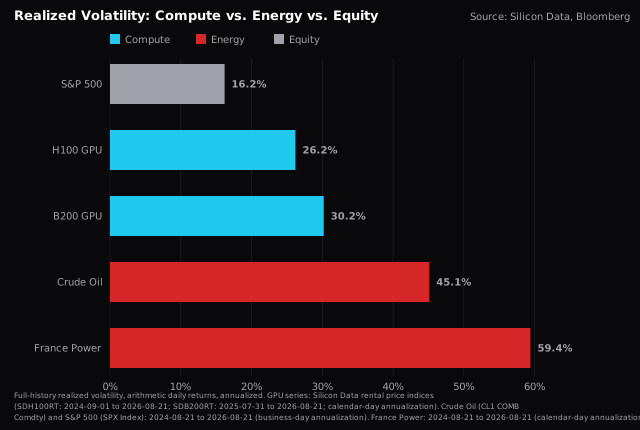
There are further requirements for success. At the contract design level, the settlement benchmark must be representative and resistant to manipulation. At the market structure level, a durable contract needs a heterogeneous mix of buyers and sellers. The commodity futures graveyard is full of large, volatile underlyings whose contracts died because flow stayed one-sided—scale alone did not summon the other side of the trade.
But requirements are downstream of prerequisites. If the risk is massive and the volatility is real, participant diversity naturally follows. A fluctuating, trillion-dollar risk factor organically attracts a spectrum of opposing hedgers, alongside the capital investors and speculators. For compute, both the physical buyers and sellers already have a rational reason to participate. Buyers—AI developers and enterprises—must hedge against surging rental costs to protect their margins. Sellers—cloud providers and the broader compute supply chain—must lock in forward revenue against overbuild and falling rental prices.
Notably absent from this list of prerequisites or requirements is Fungibility. Cash-settled compute futures do not require compute to become perfectly fungible. The constituent companies of the S&P 500 are entirely non-fungible, yet aggregating them into an index underpins a suite of exchange-traded futures and options that rank consistently among the most heavily traded derivatives in the world by notional value. For compute, stratification bridges the fungibility gap. By organizing benchmarks into distinct hardware classes- H100, B200, etc.- the indices abstract away intra-generational physical heterogeneity, while preserving the critical spread in addressable markets such as model training and inference.
The discussion points to a broader conclusion: a cash-settled compute future is a risk-management tool for everyone in the AI economy, whether the exposure is financial or physical, whether on the supply or demand side. Will there be basis risk if a specific hardware stack differs from the canonical benchmark? Yes. But as equity traders know, a discrepancy is not a barrier; it is a beta coefficient to be managed. Hedging efficiency will vary across participants and remain dynamic as the market matures, tightening as measurement improves and adoption deepens. Every commodity market that now supports efficient hedging went through the same progression, and none of them waited for a perfect match between the hedge and the exposure before starting.
Toward Physically Settled Instruments
Physically settled futures for compute rest on the same prerequisite but face an additional constraint today: limited fungibility. The logistical friction of taking delivery of heterogeneous servers keeps financial liquidity thin—as the history of tech financialization demonstrates. From the Deutsche Börse Cloud Exchange for cloud computing to early institutional efforts to trade physical DRAM, every attempt at physically delivered tech infrastructure has foundered on the same problem. That is a cautionary tale about the delivery mechanism, not about compute financialization itself. As we discussed above, cash-settled futures bypass the fungibility constraint.
Yet physically settled derivatives hold distinct utility and should not remain trapped in rigid, bilateral trades. Fungibility is a design constraint, not a fundamental barrier to trading. We have some ideas on how to address it, but the margin here is too small. We will save that for next time.