Claude Model Launches vs NVIDIA H100 Rental Prices

Claude Model Launches vs NVIDIA H100 Rental Prices

Claude Model Launches vs NVIDIA H100 Rental Prices

This data-driven analysis explores how Claude model launches correlate with NVIDIA H100 rental price spikes, revealing timing-sensitive effects across Hyperscaler, Marketplace, and Neocloud providers.

Yang Gao
Yang Gao

Written by

Yang Gao

Data Analyst at Silicon Data

#

Use Cases

Feb 4, 2026

0 Mins Read
0 Mins Read

Claude Model Launches vs NVIDIA H100 Rental Prices

Claude Model Launches vs NVIDIA H100 Rental Prices

This data-driven analysis explores how Claude model launches correlate with NVIDIA H100 rental price spikes, revealing timing-sensitive effects across Hyperscaler, Marketplace, and Neocloud providers.

Yang Gao

Written by

Yang Gao

Data Analyst at Silicon Data

#

Use Cases

Feb 4, 2026

0 Mins Read

You're reading

Claude Model Launches vs NVIDIA H100 Rental Prices

Table of Content

The generative AI arms race has reshaped demand for high-end GPUs like NVIDIA’s H100, but measuring why prices move has remained elusive. This report tackles a key hypothesis: do major foundation model releases—specifically Anthropic’s Claude models—drive immediate market reactions in H100 rental pricing?

Using real-world price indices and historical event alignment, we analyze H100 cost fluctuations across different provider types (Hyperscaler, Marketplace, and Neocloud) to identify patterns that correlate with Claude release dates. The goal: to quantify cause-and-effect where speculation usually dominates.

Our findings show measurable pricing impact around Claude milestones—and reveal how each segment of the cloud GPU market responds differently to new model pressure.

TL;DR

  • There are measurable, but source-type-specific, signals between Claude launch timing and H100 rental price movements.

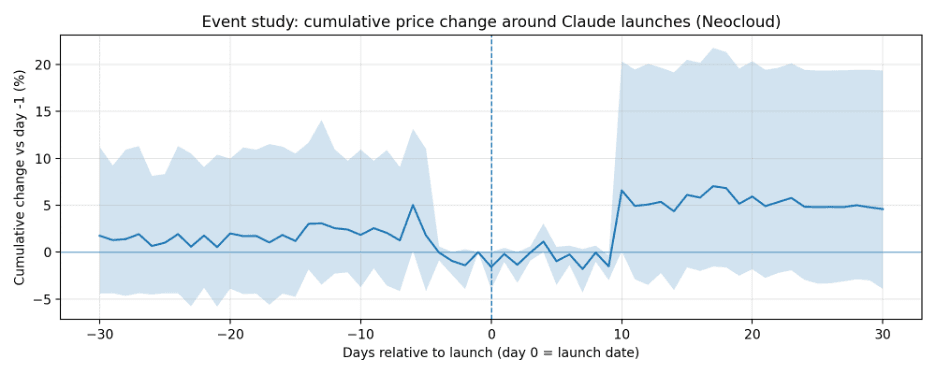
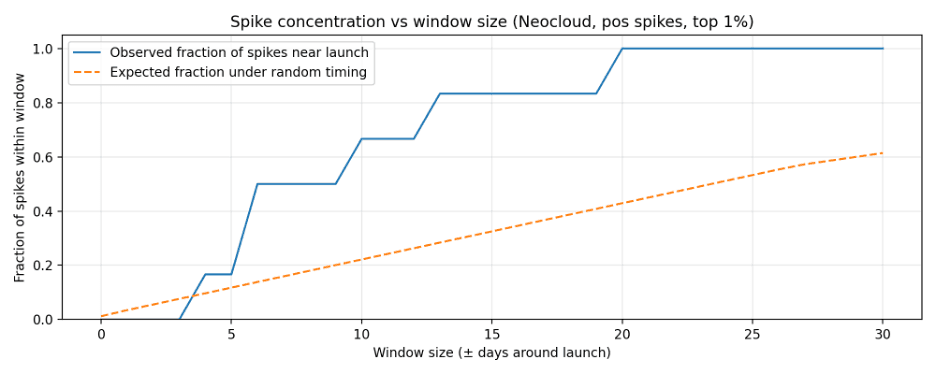
  • The clearest signal is in Neocloud pricing: top 1% positive price jumps cluster within about a 2-week window around launches (5 of 6 spikes within ±14 days; hypergeometric enrichment p=0.011).

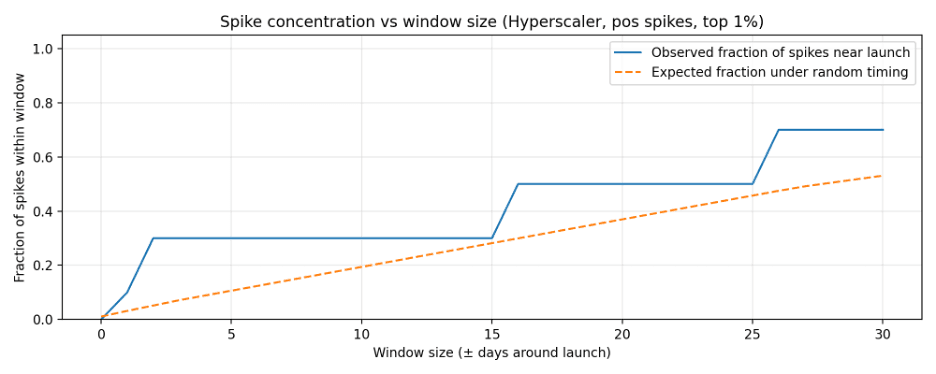
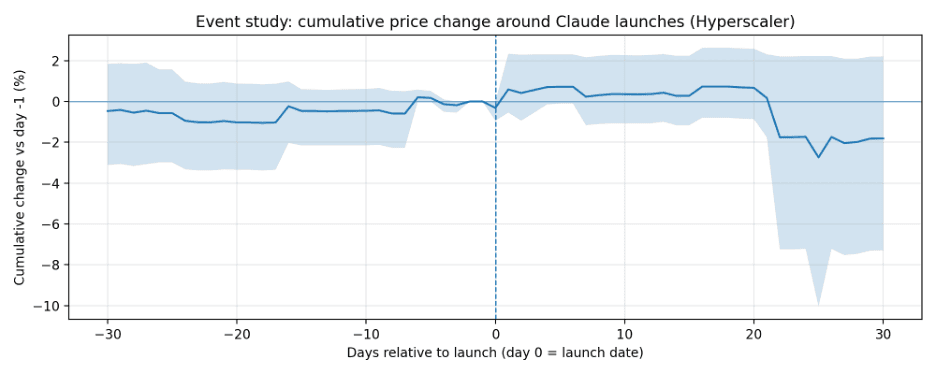
  • Hyperscaler pricing shows short-horizon concentration: 3 of the top 10 positive jumps occur within ±3 days of a launch (p=0.029). Direction is mixed: the average same-day move is slightly negative, but there is often a rebound within a few days.

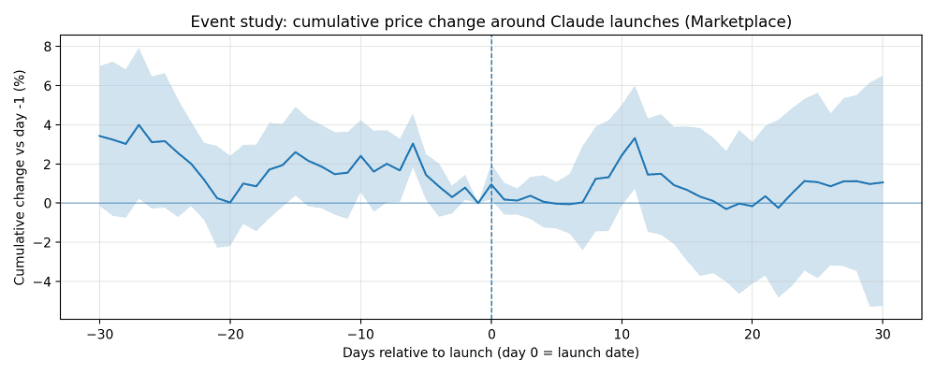
  • Marketplace pricing shows no statistically meaningful spike concentration around launches in this dataset.

  • These patterns are correlations (not causality) and are based on a small number of launch events and relatively coarse price sampling for some source types.


Claude launch calendar

Date

Launches

# launches

2024-02-29

Claude 3 Opus

1

2024-03-07

Claude 3 Haiku

1

2024-06-20

Claude 3.5 Sonnet (20240620)

1

2024-10-22

Claude 3.5 Haiku, Claude 3.5 Sonnet (20241022)

2

2025-02-19

Claude 3.7 Sonnet

1

2025-05-14

Claude Opus 4, Claude Sonnet 4

2

2025-08-05

Claude Opus 4.1

1

2025-09-29

Claude Sonnet 4.5

1

2025-10-01

Claude Haiku 4.5

1

2025-11-24

Claude Opus 4.5

1


H100 price data coverage (raw)

Source

Obs

Days

Start

End

Min

Max

Mean

Hyperscaler

913

913

2023-08-02

2026-01-30

6.06

9.387

7.956

Marketplace

586

586

2024-06-24

2026-01-30

1.838

3.546

2.293

Neocloud

507

507

2024-07-01

2026-01-30

2.436

4.572

3.069

Note: Marketplace and Neocloud series begin in mid-2024. Launches before the first observed quote for a given source_type are excluded from that source's event-window statistics.

Methodology

  • Daily time series construction: For each source_type, prices are reindexed to a daily calendar and forward-filled ("as-of" series). No backfilling is applied before the first observed quote to avoid creating artificial pre-history.

  • Return definition: Daily log-return r_t = log(P_t) - log(P_{t-1}). A "positive spike" is a day in the top 1% of r_t for that source_type.

  • Event windows: A launch day is day 0. We examine windows of ±30 days for visualization and shorter windows (±3, ±7, ±14) for spike concentration tests.

  • Event study (price level): For each launch day d, compute cumulative log change log(P_{d+k}) - log(P_{d-1}) for k in [-30, +30]. Average across launches; bootstrap across events to form 95% confidence intervals.

  • Spike enrichment test: Compare the observed number of top-1% spike days that fall within ±k days of a launch versus the expected number under random timing. A hypergeometric enrichment p-value is reported.

  • Volatility near launches: Compute the mean absolute return |r_t| on days within ±7 days of launches and compare to a random baseline using a permutation (Monte Carlo) test.

Results

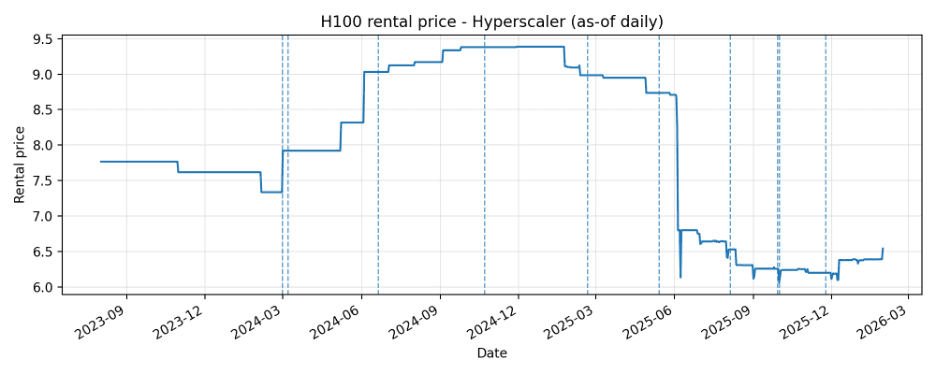
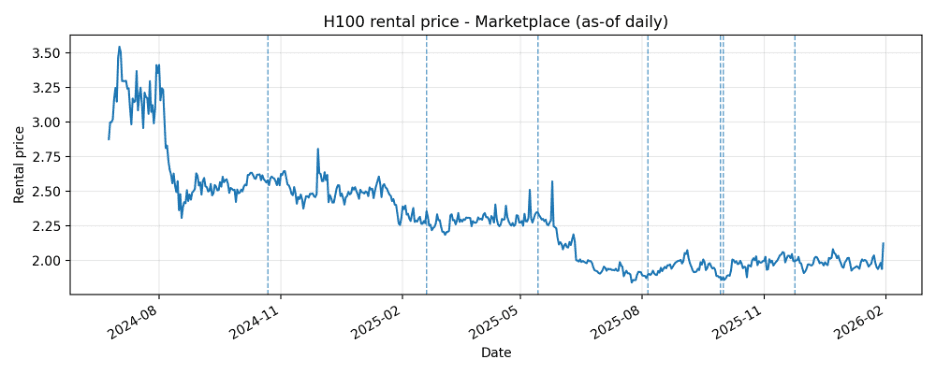
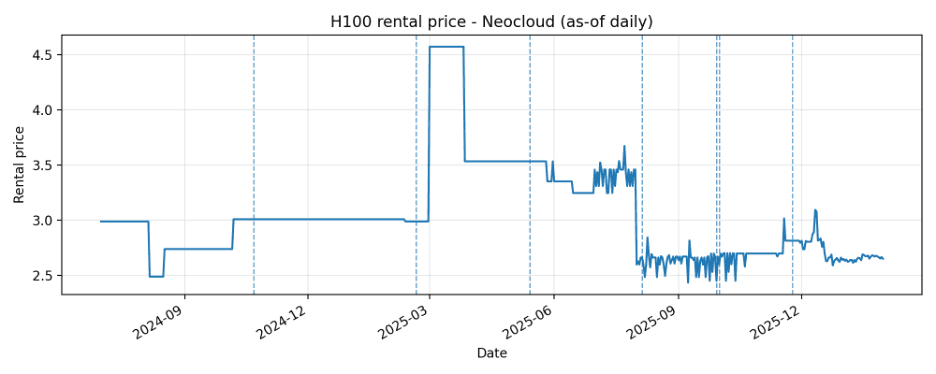
Price series with Claude launch markers

Dashed vertical lines indicate Claude launch days included for each source_type.

Hyperscaler

Marketplace

Neocloud

Event study: average cumulative price change around launches

Cumulative change is measured versus day -1. Shaded regions are 95% bootstrap confidence intervals.

Hyperscaler

Marketplace

Neocloud

Positive spike concentration around launches

Definition: positive spike = top 1% daily log-return for that source_type. The enrichment p-value tests whether the observed number of spikes near launches is higher than expected under random timing.


Positive spike enrichment (top 1% daily returns)

Source

Window (±days)

# spikes

# near

Expected share

Observed share

p (enrich)

Hyperscaler

3

10

3

0.071

0.3

0.0289

Hyperscaler

7

10

3

0.141

0.3

0.1571

Hyperscaler

14

10

3

0.264

0.3

0.5174

Marketplace

3

6

0

0.075

0.0

1.0000

Marketplace

7

6

1

0.157

0.167

0.6435

Marketplace

14

6

2

0.301

0.333

0.5826

Neocloud

3

6

0

0.076

0.0

1.0000

Neocloud

7

6

3

0.159

0.5

0.0543

Neocloud

14

6

5

0.304

0.833

0.0113


Volatility near launches

Permutation p-value tests whether mean |return| is higher on near-launch days (±7) than under random timing.

Near-launch volatility test (±7 days)

Source

Window (±days)

Near days

Total days

Mean |r| (near)

Mean |r| (null)

p (greater)

Hyperscaler

7

129

912

0.0019

0.0014

0.2296

Marketplace

7

92

585

0.0112

0.0151

0.9900

Neocloud

7

92

578

0.0203

0.0112

0.0123


Notable Neocloud spike instances

Top 1% positive Neocloud return days, mapped to the nearest Claude launch:

Spike date

Approx. +%

Nearest launch

Lag (days)

Launch

2025-03-01

52.9

2025-02-19

10

Claude 3.7 Sonnet

2025-09-09

15.6

2025-09-29

-20

Claude Sonnet 4.5

2025-09-25

10.1

2025-09-29

-4

Claude Sonnet 4.5

2025-10-07

10.2

2025-10-01

6

Claude Haiku 4.5

2025-10-14

10.1

2025-10-01

13

Claude Haiku 4.5

2025-11-18

11.8

2025-11-24

-6

Claude Opus 4.5


Spike-window concentration curves (Neocloud and Hyperscaler):

Permutation tests on event-day and short-horizon moves

These tests compare launch-day metrics to randomly sampled dates (excluding ±30 days around launches). Max |cum. move| (0..7) is the maximum absolute cumulative move within days 0..7 relative to day -1.

Source

Metric

Actual mean

Null mean

p (two-sided)

p (>)

p (<)

# events

Hyperscaler

Return on day 0

-0.0032

0.0001

0.0256

0.9989

0.0012

10

Hyperscaler

Max cum. move (0..7)

0.0074

0.0015

0.0198

0.0197

0.9803

10

Hyperscaler

Max |cum. move| (0..7)

0.0189

0.0029

<0.0001

<0.0001

1.0000

10

Marketplace

Return on day 0

0.0095

-0.0006

0.3290

0.1635

0.8366

7

Marketplace

Max cum. move (0..7)

0.026

0.0295

0.8325

0.5504

0.4496

7

Marketplace

Max |cum. move| (0..7)

0.0359

0.0607

0.1474

0.9447

0.0554

7

Neocloud

Return on day 0

-0.0159

-0.0012

0.0867

0.9390

0.0611

7

Neocloud

Max cum. move (0..7)

0.0129

0.0061

0.3692

0.2852

0.7149

7

Neocloud

Max |cum. move| (0..7)

0.0352

0.0234

0.6454

0.2824

0.7176

7


Interpretation and limitations

  • Segment differences matter. Signals are most visible in Neocloud and (to a lesser extent) Hyperscaler; Marketplace appears less responsive in this sample.

  • Timing is not purely same-day. For Neocloud, several spike days occur a few days before/after launches, and one very large spike occurs 10 days after the 2025-02-19 launch (Claude 3.7 Sonnet). This is consistent with market adjustments or demand/supply shifts that lag announcements.

  • Confounding is likely. H100 pricing is influenced by many factors (supply availability, competitor launches, broader AI demand, outages, contract repricing cadence). This analysis does not isolate causal effects.

  • Sample size is small. Marketplace/Neocloud only have 7 usable launch windows, so statistical power is limited and confidence intervals are wide.


Conclusion

  • There is evidence of correlation between Claude launch timing and H100 rental price spikes, but it is not uniform across source types.

  • Neocloud shows the strongest signal: positive spikes concentrate within ±14 days of launches (p=0.011).

  • Hyperscaler shows short-window concentration (±3 days; p=0.029) and elevated short-horizon movement in 0..7 days (permutation p < 0.0001), though direction is mixed.

  • Marketplace shows no robust spike concentration signal in this dataset.


Forward-looking next steps

  • Add control events: include other frontier model launches (OpenAI, Google, etc.) to test whether the signal is Claude-specific or reflects broader AI demand cycles.

  • Use richer market features: incorporate utilization/availability metrics (if accessible) and separate spot vs reserved pricing; spikes in price without volume can be misleading.

  • Move from correlation to causal inference: build a synthetic control (or difference-in-differences) using non-launch periods and/or other GPU SKUs as controls.

  • Model lead/lag explicitly: regress returns on distributed lags/leads of launch indicators to estimate a response curve and isolate typical delay patterns.


Appendix Code:

The following script reproduces the analysis and plots:
# Claude launch vs H100 rental price spike analysis
# Inputs:
#   - claude_launch.csv (columns: model_name, version_date)
#   - h100_price.csv    (columns: date, source_type, rental_price)

import os
from datetime import date
import numpy as np
import pandas as pd
import matplotlib.pyplot as plt
import matplotlib.dates as mdates
from scipy.stats import hypergeom

# ----------------------------
# Load data
# ----------------------------
claude = pd.read_csv("claude_launch.csv")
h100 = pd.read_csv("h100_price.csv")

claude["version_date"] = pd.to_datetime(claude["version_date"]).dt.normalize()
h100["date"] = pd.to_datetime(h100["date"]).dt.normalize()
h100 = h100.dropna(subset=["source_type"]).copy()

# Aggregate launches by day (some days have multiple model releases)
launches_by_date = (
    claude.groupby("version_date")["model_name"]
    .apply(lambda x: ", ".join(sorted(x)))
    .to_dict()
)
launch_counts = claude["version_date"].value_counts().sort_index()

event_days_all = sorted(launch_counts.index.tolist())

# ----------------------------
# Build daily "as-of" price series per source_type (forward-fill only)
# ----------------------------
date_range = pd.date_range(h100["date"].min(), h100["date"].max(), freq="D")

price_asof = {}
for st, dfst in h100.groupby("source_type"):
    s = dfst.set_index("date").sort_index()["rental_price"]
    # forward-fill; keep NaN before first observation (no backfill)
    price_asof[st] = s.reindex(date_range).ffill()

price_asof_df = pd.DataFrame(price_asof)

log_price = np.log(price_asof_df)
returns = log_price.diff()

# Valid event days must have data at d-1 and d+7 (for 0..7 metrics)
valid_events = {}
for st in price_asof_df.columns:
    lp = log_price[st]
    evs = []
    for d in event_days_all:
        if (d - pd.Timedelta(days=1) in lp.index) and (d + pd.Timedelta(days=7) in lp.index):
            if pd.notna(lp.loc[d - pd.Timedelta(days=1)]) and pd.notna(lp.loc[d + pd.Timedelta(days=7)]):
                evs.append(d)
    valid_events[st] = evs

# ----------------------------
# Spike enrichment test
# ----------------------------
def spike_enrichment(st: str, window: int, q: float = 0.99) -> dict:
    """Top (1-q) positive spikes concentration within +/- window days of launches."""
    rs = returns[st].dropna()
    idx = rs.index
    evs = valid_events[st]

    # days covered by event windows
    near = set()
    for d in evs:
        for k in range(-window, window + 1):
            dt = d + pd.Timedelta(days=k)
            if dt in idx:
                near.add(dt)

    N = len(idx)         # population size (days)
    K = len(near)        # "success" days (near launch)
    thresh = rs.quantile(q)
    spikes = rs[rs >= thresh].index
    n = len(spikes)      # number of spike days
    x = sum([1 for d in spikes if d in near])

    expected = n * K / N
    p_enrich = hypergeom(N, K, n).sf(x - 1)  # P(X >= x)
    return {
        "source_type": st,
        "window": window,
        "threshold": float(thresh),
        "N_days": N,
        "near_days": K,
        "num_spikes": n,
        "spikes_near": x,
        "expected_near": expected,
        "p_enrichment": float(p_enrich),
    }

# Example: compute for multiple windows
spike_rows = []
for st in price_asof_df.columns:
    for w in [3, 7, 14]:
        spike_rows.append(spike_enrichment(st, w, q=0.99))
spike_df = pd.DataFrame(spike_rows)

# ----------------------------
# Event study (average cumulative % change around launches)
# ----------------------------
def bootstrap_ci(mat: np.ndarray, n_boot: int = 3000, ci: float = 0.95, seed: int = 0):
    rng = np.random.default_rng(seed)
    n = mat.shape[0]
    boot_means = []
    for _ in range(n_boot):
        sample = mat[rng.integers(0, n, size=n)]
        boot_means.append(sample.mean(axis=0))
    boot_means = np.vstack(boot_means)
    alpha = (1 - ci) / 2
    lower = np.quantile(boot_means, alpha, axis=0)
    upper = np.quantile(boot_means, 1 - alpha, axis=0)
    return lower, upper

def event_study_paths(st: str, W: int = 30):
    lp = log_price[st]
    evs = valid_events[st]
    rel_days = np.arange(-W, W + 1)

    mat = []
    for d in evs:
        idx = d + pd.to_timedelta(rel_days, unit="D")
        baseline = lp.loc[d - pd.Timedelta(days=1)]
        mat.append(lp.reindex(idx).values - baseline)
    mat = np.vstack(mat)

    mean_log = mat.mean(axis=0)
    lo, hi = bootstrap_ci(mat, n_boot=3000, seed=7)

    mean_pct = (np.exp(mean_log) - 1) * 100
    lo_pct = (np.exp(lo) - 1) * 100
    hi_pct = (np.exp(hi) - 1) * 100
    return rel_days, mean_pct, lo_pct, hi_pct

# ----------------------------
# Plotting helpers
# ----------------------------
OUTDIR = "claude_h100_report_assets"
os.makedirs(OUTDIR, exist_ok=True)

def save_price_plot(st: str):
    s = price_asof_df[st].dropna()
    fig, ax = plt.subplots(figsize=(10, 4))
    ax.plot(s.index, s.values)
    for d in valid_events[st]:
        ax.axvline(d, linestyle="--", linewidth=1, alpha=0.7)
    ax.set_title(f"H100 rental price - {st} (as-of daily)")
    ax.set_xlabel("Date")
    ax.set_ylabel("Rental price")
    ax.xaxis.set_major_locator(mdates.MonthLocator(interval=3))
    ax.xaxis.set_major_formatter(mdates.DateFormatter("%Y-%m"))
    fig.autofmt_xdate()
    ax.grid(True, alpha=0.3)
    path = os.path.join(OUTDIR, f"price_{st}.png")
    fig.tight_layout()
    fig.savefig(path, dpi=200)
    plt.close(fig)

def save_event_study_plot(st: str, W: int = 30):
    x, mean_pct, lo_pct, hi_pct = event_study_paths(st, W=W)
    fig, ax = plt.subplots(figsize=(10, 4))
    ax.plot(x, mean_pct, label="Mean")
    ax.fill_between(x, lo_pct, hi_pct, alpha=0.2, label="95% CI")
    ax.axvline(0, linestyle="--", linewidth=1)
    ax.axhline(0, linewidth=1, alpha=0.5)
    ax.set_title(f"Event study: cumulative price change around Claude launches ({st})")
    ax.set_xlabel("Days relative to launch (day 0 = launch date)")
    ax.set_ylabel("Cumulative change vs day -1 (%)")
    ax.grid(True, alpha=0.3)
    path = os.path.join(OUTDIR, f"event_study_{st}.png")
    fig.tight_layout()
    fig.savefig(path, dpi=200)
    plt.close(fig)

for st in price_asof_df.columns:
    save_price_plot(st)
    save_event_study_plot(st)

print("Done. Plots saved to:", OUTDIR)
print("Spike enrichment summary (top 1% positive spikes):")
print(spike_df[["source_type", "window", "num_spikes", "spikes_near", "p_enrichment"]])

The following script reproduces the analysis and plots:
# Claude launch vs H100 rental price spike analysis
# Inputs:
#   - claude_launch.csv (columns: model_name, version_date)
#   - h100_price.csv    (columns: date, source_type, rental_price)

import os
from datetime import date
import numpy as np
import pandas as pd
import matplotlib.pyplot as plt
import matplotlib.dates as mdates
from scipy.stats import hypergeom

# ----------------------------
# Load data
# ----------------------------
claude = pd.read_csv("claude_launch.csv")
h100 = pd.read_csv("h100_price.csv")

claude["version_date"] = pd.to_datetime(claude["version_date"]).dt.normalize()
h100["date"] = pd.to_datetime(h100["date"]).dt.normalize()
h100 = h100.dropna(subset=["source_type"]).copy()

# Aggregate launches by day (some days have multiple model releases)
launches_by_date = (
    claude.groupby("version_date")["model_name"]
    .apply(lambda x: ", ".join(sorted(x)))
    .to_dict()
)
launch_counts = claude["version_date"].value_counts().sort_index()

event_days_all = sorted(launch_counts.index.tolist())

# ----------------------------
# Build daily "as-of" price series per source_type (forward-fill only)
# ----------------------------
date_range = pd.date_range(h100["date"].min(), h100["date"].max(), freq="D")

price_asof = {}
for st, dfst in h100.groupby("source_type"):
    s = dfst.set_index("date").sort_index()["rental_price"]
    # forward-fill; keep NaN before first observation (no backfill)
    price_asof[st] = s.reindex(date_range).ffill()

price_asof_df = pd.DataFrame(price_asof)

log_price = np.log(price_asof_df)
returns = log_price.diff()

# Valid event days must have data at d-1 and d+7 (for 0..7 metrics)
valid_events = {}
for st in price_asof_df.columns:
    lp = log_price[st]
    evs = []
    for d in event_days_all:
        if (d - pd.Timedelta(days=1) in lp.index) and (d + pd.Timedelta(days=7) in lp.index):
            if pd.notna(lp.loc[d - pd.Timedelta(days=1)]) and pd.notna(lp.loc[d + pd.Timedelta(days=7)]):
                evs.append(d)
    valid_events[st] = evs

# ----------------------------
# Spike enrichment test
# ----------------------------
def spike_enrichment(st: str, window: int, q: float = 0.99) -> dict:
    """Top (1-q) positive spikes concentration within +/- window days of launches."""
    rs = returns[st].dropna()
    idx = rs.index
    evs = valid_events[st]

    # days covered by event windows
    near = set()
    for d in evs:
        for k in range(-window, window + 1):
            dt = d + pd.Timedelta(days=k)
            if dt in idx:
                near.add(dt)

    N = len(idx)         # population size (days)
    K = len(near)        # "success" days (near launch)
    thresh = rs.quantile(q)
    spikes = rs[rs >= thresh].index
    n = len(spikes)      # number of spike days
    x = sum([1 for d in spikes if d in near])

    expected = n * K / N
    p_enrich = hypergeom(N, K, n).sf(x - 1)  # P(X >= x)
    return {
        "source_type": st,
        "window": window,
        "threshold": float(thresh),
        "N_days": N,
        "near_days": K,
        "num_spikes": n,
        "spikes_near": x,
        "expected_near": expected,
        "p_enrichment": float(p_enrich),
    }

# Example: compute for multiple windows
spike_rows = []
for st in price_asof_df.columns:
    for w in [3, 7, 14]:
        spike_rows.append(spike_enrichment(st, w, q=0.99))
spike_df = pd.DataFrame(spike_rows)

# ----------------------------
# Event study (average cumulative % change around launches)
# ----------------------------
def bootstrap_ci(mat: np.ndarray, n_boot: int = 3000, ci: float = 0.95, seed: int = 0):
    rng = np.random.default_rng(seed)
    n = mat.shape[0]
    boot_means = []
    for _ in range(n_boot):
        sample = mat[rng.integers(0, n, size=n)]
        boot_means.append(sample.mean(axis=0))
    boot_means = np.vstack(boot_means)
    alpha = (1 - ci) / 2
    lower = np.quantile(boot_means, alpha, axis=0)
    upper = np.quantile(boot_means, 1 - alpha, axis=0)
    return lower, upper

def event_study_paths(st: str, W: int = 30):
    lp = log_price[st]
    evs = valid_events[st]
    rel_days = np.arange(-W, W + 1)

    mat = []
    for d in evs:
        idx = d + pd.to_timedelta(rel_days, unit="D")
        baseline = lp.loc[d - pd.Timedelta(days=1)]
        mat.append(lp.reindex(idx).values - baseline)
    mat = np.vstack(mat)

    mean_log = mat.mean(axis=0)
    lo, hi = bootstrap_ci(mat, n_boot=3000, seed=7)

    mean_pct = (np.exp(mean_log) - 1) * 100
    lo_pct = (np.exp(lo) - 1) * 100
    hi_pct = (np.exp(hi) - 1) * 100
    return rel_days, mean_pct, lo_pct, hi_pct

# ----------------------------
# Plotting helpers
# ----------------------------
OUTDIR = "claude_h100_report_assets"
os.makedirs(OUTDIR, exist_ok=True)

def save_price_plot(st: str):
    s = price_asof_df[st].dropna()
    fig, ax = plt.subplots(figsize=(10, 4))
    ax.plot(s.index, s.values)
    for d in valid_events[st]:
        ax.axvline(d, linestyle="--", linewidth=1, alpha=0.7)
    ax.set_title(f"H100 rental price - {st} (as-of daily)")
    ax.set_xlabel("Date")
    ax.set_ylabel("Rental price")
    ax.xaxis.set_major_locator(mdates.MonthLocator(interval=3))
    ax.xaxis.set_major_formatter(mdates.DateFormatter("%Y-%m"))
    fig.autofmt_xdate()
    ax.grid(True, alpha=0.3)
    path = os.path.join(OUTDIR, f"price_{st}.png")
    fig.tight_layout()
    fig.savefig(path, dpi=200)
    plt.close(fig)

def save_event_study_plot(st: str, W: int = 30):
    x, mean_pct, lo_pct, hi_pct = event_study_paths(st, W=W)
    fig, ax = plt.subplots(figsize=(10, 4))
    ax.plot(x, mean_pct, label="Mean")
    ax.fill_between(x, lo_pct, hi_pct, alpha=0.2, label="95% CI")
    ax.axvline(0, linestyle="--", linewidth=1)
    ax.axhline(0, linewidth=1, alpha=0.5)
    ax.set_title(f"Event study: cumulative price change around Claude launches ({st})")
    ax.set_xlabel("Days relative to launch (day 0 = launch date)")
    ax.set_ylabel("Cumulative change vs day -1 (%)")
    ax.grid(True, alpha=0.3)
    path = os.path.join(OUTDIR, f"event_study_{st}.png")
    fig.tight_layout()
    fig.savefig(path, dpi=200)
    plt.close(fig)

for st in price_asof_df.columns:
    save_price_plot(st)
    save_event_study_plot(st)

print("Done. Plots saved to:", OUTDIR)
print("Spike enrichment summary (top 1% positive spikes):")
print(spike_df[["source_type", "window", "num_spikes", "spikes_near", "p_enrichment"]])

The following script reproduces the analysis and plots:
# Claude launch vs H100 rental price spike analysis
# Inputs:
#   - claude_launch.csv (columns: model_name, version_date)
#   - h100_price.csv    (columns: date, source_type, rental_price)

import os
from datetime import date
import numpy as np
import pandas as pd
import matplotlib.pyplot as plt
import matplotlib.dates as mdates
from scipy.stats import hypergeom

# ----------------------------
# Load data
# ----------------------------
claude = pd.read_csv("claude_launch.csv")
h100 = pd.read_csv("h100_price.csv")

claude["version_date"] = pd.to_datetime(claude["version_date"]).dt.normalize()
h100["date"] = pd.to_datetime(h100["date"]).dt.normalize()
h100 = h100.dropna(subset=["source_type"]).copy()

# Aggregate launches by day (some days have multiple model releases)
launches_by_date = (
    claude.groupby("version_date")["model_name"]
    .apply(lambda x: ", ".join(sorted(x)))
    .to_dict()
)
launch_counts = claude["version_date"].value_counts().sort_index()

event_days_all = sorted(launch_counts.index.tolist())

# ----------------------------
# Build daily "as-of" price series per source_type (forward-fill only)
# ----------------------------
date_range = pd.date_range(h100["date"].min(), h100["date"].max(), freq="D")

price_asof = {}
for st, dfst in h100.groupby("source_type"):
    s = dfst.set_index("date").sort_index()["rental_price"]
    # forward-fill; keep NaN before first observation (no backfill)
    price_asof[st] = s.reindex(date_range).ffill()

price_asof_df = pd.DataFrame(price_asof)

log_price = np.log(price_asof_df)
returns = log_price.diff()

# Valid event days must have data at d-1 and d+7 (for 0..7 metrics)
valid_events = {}
for st in price_asof_df.columns:
    lp = log_price[st]
    evs = []
    for d in event_days_all:
        if (d - pd.Timedelta(days=1) in lp.index) and (d + pd.Timedelta(days=7) in lp.index):
            if pd.notna(lp.loc[d - pd.Timedelta(days=1)]) and pd.notna(lp.loc[d + pd.Timedelta(days=7)]):
                evs.append(d)
    valid_events[st] = evs

# ----------------------------
# Spike enrichment test
# ----------------------------
def spike_enrichment(st: str, window: int, q: float = 0.99) -> dict:
    """Top (1-q) positive spikes concentration within +/- window days of launches."""
    rs = returns[st].dropna()
    idx = rs.index
    evs = valid_events[st]

    # days covered by event windows
    near = set()
    for d in evs:
        for k in range(-window, window + 1):
            dt = d + pd.Timedelta(days=k)
            if dt in idx:
                near.add(dt)

    N = len(idx)         # population size (days)
    K = len(near)        # "success" days (near launch)
    thresh = rs.quantile(q)
    spikes = rs[rs >= thresh].index
    n = len(spikes)      # number of spike days
    x = sum([1 for d in spikes if d in near])

    expected = n * K / N
    p_enrich = hypergeom(N, K, n).sf(x - 1)  # P(X >= x)
    return {
        "source_type": st,
        "window": window,
        "threshold": float(thresh),
        "N_days": N,
        "near_days": K,
        "num_spikes": n,
        "spikes_near": x,
        "expected_near": expected,
        "p_enrichment": float(p_enrich),
    }

# Example: compute for multiple windows
spike_rows = []
for st in price_asof_df.columns:
    for w in [3, 7, 14]:
        spike_rows.append(spike_enrichment(st, w, q=0.99))
spike_df = pd.DataFrame(spike_rows)

# ----------------------------
# Event study (average cumulative % change around launches)
# ----------------------------
def bootstrap_ci(mat: np.ndarray, n_boot: int = 3000, ci: float = 0.95, seed: int = 0):
    rng = np.random.default_rng(seed)
    n = mat.shape[0]
    boot_means = []
    for _ in range(n_boot):
        sample = mat[rng.integers(0, n, size=n)]
        boot_means.append(sample.mean(axis=0))
    boot_means = np.vstack(boot_means)
    alpha = (1 - ci) / 2
    lower = np.quantile(boot_means, alpha, axis=0)
    upper = np.quantile(boot_means, 1 - alpha, axis=0)
    return lower, upper

def event_study_paths(st: str, W: int = 30):
    lp = log_price[st]
    evs = valid_events[st]
    rel_days = np.arange(-W, W + 1)

    mat = []
    for d in evs:
        idx = d + pd.to_timedelta(rel_days, unit="D")
        baseline = lp.loc[d - pd.Timedelta(days=1)]
        mat.append(lp.reindex(idx).values - baseline)
    mat = np.vstack(mat)

    mean_log = mat.mean(axis=0)
    lo, hi = bootstrap_ci(mat, n_boot=3000, seed=7)

    mean_pct = (np.exp(mean_log) - 1) * 100
    lo_pct = (np.exp(lo) - 1) * 100
    hi_pct = (np.exp(hi) - 1) * 100
    return rel_days, mean_pct, lo_pct, hi_pct

# ----------------------------
# Plotting helpers
# ----------------------------
OUTDIR = "claude_h100_report_assets"
os.makedirs(OUTDIR, exist_ok=True)

def save_price_plot(st: str):
    s = price_asof_df[st].dropna()
    fig, ax = plt.subplots(figsize=(10, 4))
    ax.plot(s.index, s.values)
    for d in valid_events[st]:
        ax.axvline(d, linestyle="--", linewidth=1, alpha=0.7)
    ax.set_title(f"H100 rental price - {st} (as-of daily)")
    ax.set_xlabel("Date")
    ax.set_ylabel("Rental price")
    ax.xaxis.set_major_locator(mdates.MonthLocator(interval=3))
    ax.xaxis.set_major_formatter(mdates.DateFormatter("%Y-%m"))
    fig.autofmt_xdate()
    ax.grid(True, alpha=0.3)
    path = os.path.join(OUTDIR, f"price_{st}.png")
    fig.tight_layout()
    fig.savefig(path, dpi=200)
    plt.close(fig)

def save_event_study_plot(st: str, W: int = 30):
    x, mean_pct, lo_pct, hi_pct = event_study_paths(st, W=W)
    fig, ax = plt.subplots(figsize=(10, 4))
    ax.plot(x, mean_pct, label="Mean")
    ax.fill_between(x, lo_pct, hi_pct, alpha=0.2, label="95% CI")
    ax.axvline(0, linestyle="--", linewidth=1)
    ax.axhline(0, linewidth=1, alpha=0.5)
    ax.set_title(f"Event study: cumulative price change around Claude launches ({st})")
    ax.set_xlabel("Days relative to launch (day 0 = launch date)")
    ax.set_ylabel("Cumulative change vs day -1 (%)")
    ax.grid(True, alpha=0.3)
    path = os.path.join(OUTDIR, f"event_study_{st}.png")
    fig.tight_layout()
    fig.savefig(path, dpi=200)
    plt.close(fig)

for st in price_asof_df.columns:
    save_price_plot(st)
    save_event_study_plot(st)

print("Done. Plots saved to:", OUTDIR)
print("Spike enrichment summary (top 1% positive spikes):")
print(spike_df[["source_type", "window", "num_spikes", "spikes_near", "p_enrichment"]])

The following script reproduces the analysis and plots:
# Claude launch vs H100 rental price spike analysis
# Inputs:
#   - claude_launch.csv (columns: model_name, version_date)
#   - h100_price.csv    (columns: date, source_type, rental_price)

import os
from datetime import date
import numpy as np
import pandas as pd
import matplotlib.pyplot as plt
import matplotlib.dates as mdates
from scipy.stats import hypergeom

# ----------------------------
# Load data
# ----------------------------
claude = pd.read_csv("claude_launch.csv")
h100 = pd.read_csv("h100_price.csv")

claude["version_date"] = pd.to_datetime(claude["version_date"]).dt.normalize()
h100["date"] = pd.to_datetime(h100["date"]).dt.normalize()
h100 = h100.dropna(subset=["source_type"]).copy()

# Aggregate launches by day (some days have multiple model releases)
launches_by_date = (
    claude.groupby("version_date")["model_name"]
    .apply(lambda x: ", ".join(sorted(x)))
    .to_dict()
)
launch_counts = claude["version_date"].value_counts().sort_index()

event_days_all = sorted(launch_counts.index.tolist())

# ----------------------------
# Build daily "as-of" price series per source_type (forward-fill only)
# ----------------------------
date_range = pd.date_range(h100["date"].min(), h100["date"].max(), freq="D")

price_asof = {}
for st, dfst in h100.groupby("source_type"):
    s = dfst.set_index("date").sort_index()["rental_price"]
    # forward-fill; keep NaN before first observation (no backfill)
    price_asof[st] = s.reindex(date_range).ffill()

price_asof_df = pd.DataFrame(price_asof)

log_price = np.log(price_asof_df)
returns = log_price.diff()

# Valid event days must have data at d-1 and d+7 (for 0..7 metrics)
valid_events = {}
for st in price_asof_df.columns:
    lp = log_price[st]
    evs = []
    for d in event_days_all:
        if (d - pd.Timedelta(days=1) in lp.index) and (d + pd.Timedelta(days=7) in lp.index):
            if pd.notna(lp.loc[d - pd.Timedelta(days=1)]) and pd.notna(lp.loc[d + pd.Timedelta(days=7)]):
                evs.append(d)
    valid_events[st] = evs

# ----------------------------
# Spike enrichment test
# ----------------------------
def spike_enrichment(st: str, window: int, q: float = 0.99) -> dict:
    """Top (1-q) positive spikes concentration within +/- window days of launches."""
    rs = returns[st].dropna()
    idx = rs.index
    evs = valid_events[st]

    # days covered by event windows
    near = set()
    for d in evs:
        for k in range(-window, window + 1):
            dt = d + pd.Timedelta(days=k)
            if dt in idx:
                near.add(dt)

    N = len(idx)         # population size (days)
    K = len(near)        # "success" days (near launch)
    thresh = rs.quantile(q)
    spikes = rs[rs >= thresh].index
    n = len(spikes)      # number of spike days
    x = sum([1 for d in spikes if d in near])

    expected = n * K / N
    p_enrich = hypergeom(N, K, n).sf(x - 1)  # P(X >= x)
    return {
        "source_type": st,
        "window": window,
        "threshold": float(thresh),
        "N_days": N,
        "near_days": K,
        "num_spikes": n,
        "spikes_near": x,
        "expected_near": expected,
        "p_enrichment": float(p_enrich),
    }

# Example: compute for multiple windows
spike_rows = []
for st in price_asof_df.columns:
    for w in [3, 7, 14]:
        spike_rows.append(spike_enrichment(st, w, q=0.99))
spike_df = pd.DataFrame(spike_rows)

# ----------------------------
# Event study (average cumulative % change around launches)
# ----------------------------
def bootstrap_ci(mat: np.ndarray, n_boot: int = 3000, ci: float = 0.95, seed: int = 0):
    rng = np.random.default_rng(seed)
    n = mat.shape[0]
    boot_means = []
    for _ in range(n_boot):
        sample = mat[rng.integers(0, n, size=n)]
        boot_means.append(sample.mean(axis=0))
    boot_means = np.vstack(boot_means)
    alpha = (1 - ci) / 2
    lower = np.quantile(boot_means, alpha, axis=0)
    upper = np.quantile(boot_means, 1 - alpha, axis=0)
    return lower, upper

def event_study_paths(st: str, W: int = 30):
    lp = log_price[st]
    evs = valid_events[st]
    rel_days = np.arange(-W, W + 1)

    mat = []
    for d in evs:
        idx = d + pd.to_timedelta(rel_days, unit="D")
        baseline = lp.loc[d - pd.Timedelta(days=1)]
        mat.append(lp.reindex(idx).values - baseline)
    mat = np.vstack(mat)

    mean_log = mat.mean(axis=0)
    lo, hi = bootstrap_ci(mat, n_boot=3000, seed=7)

    mean_pct = (np.exp(mean_log) - 1) * 100
    lo_pct = (np.exp(lo) - 1) * 100
    hi_pct = (np.exp(hi) - 1) * 100
    return rel_days, mean_pct, lo_pct, hi_pct

# ----------------------------
# Plotting helpers
# ----------------------------
OUTDIR = "claude_h100_report_assets"
os.makedirs(OUTDIR, exist_ok=True)

def save_price_plot(st: str):
    s = price_asof_df[st].dropna()
    fig, ax = plt.subplots(figsize=(10, 4))
    ax.plot(s.index, s.values)
    for d in valid_events[st]:
        ax.axvline(d, linestyle="--", linewidth=1, alpha=0.7)
    ax.set_title(f"H100 rental price - {st} (as-of daily)")
    ax.set_xlabel("Date")
    ax.set_ylabel("Rental price")
    ax.xaxis.set_major_locator(mdates.MonthLocator(interval=3))
    ax.xaxis.set_major_formatter(mdates.DateFormatter("%Y-%m"))
    fig.autofmt_xdate()
    ax.grid(True, alpha=0.3)
    path = os.path.join(OUTDIR, f"price_{st}.png")
    fig.tight_layout()
    fig.savefig(path, dpi=200)
    plt.close(fig)

def save_event_study_plot(st: str, W: int = 30):
    x, mean_pct, lo_pct, hi_pct = event_study_paths(st, W=W)
    fig, ax = plt.subplots(figsize=(10, 4))
    ax.plot(x, mean_pct, label="Mean")
    ax.fill_between(x, lo_pct, hi_pct, alpha=0.2, label="95% CI")
    ax.axvline(0, linestyle="--", linewidth=1)
    ax.axhline(0, linewidth=1, alpha=0.5)
    ax.set_title(f"Event study: cumulative price change around Claude launches ({st})")
    ax.set_xlabel("Days relative to launch (day 0 = launch date)")
    ax.set_ylabel("Cumulative change vs day -1 (%)")
    ax.grid(True, alpha=0.3)
    path = os.path.join(OUTDIR, f"event_study_{st}.png")
    fig.tight_layout()
    fig.savefig(path, dpi=200)
    plt.close(fig)

for st in price_asof_df.columns:
    save_price_plot(st)
    save_event_study_plot(st)

print("Done. Plots saved to:", OUTDIR)
print("Spike enrichment summary (top 1% positive spikes):")
print(spike_df[["source_type", "window", "num_spikes", "spikes_near", "p_enrichment"]])

Yang Gao
Yang Gao

Written by

Yang Gao

Data Analyst at Silicon Data

Share this story

Subscribe to our Newsletter

Articles you may like

Make better compute decisions today

Realtime price transparency & GPU performancedata for traders, financial institutions, and builders.

© 2025 Silicon Data® is a registered trademark of Silicon Data Inc. All rights reserved.

Ask AI for a summary of Silicon Data

Make better compute decisions today

Realtime price transparency & GPU performancedata for traders, financial institutions, and builders.

© 2025 Silicon Data® is a registered trademark of Silicon Data Inc. All rights reserved.

Ask AI for a summary of Silicon Data

Make better compute decisions today

Realtime price transparency & GPU performancedata for traders, financial institutions, and builders.

© 2025 Silicon Data® is a registered trademark of Silicon Data Inc. All rights reserved.

Ask AI for a summary of Silicon Data